Integrative Conservation Clinic

Integrative Conservation Clinic is an open-source research platform by William & Mary Institute for conservationists to collaboratively research and share subject findings.

Ecological
Conservationists
Pain Points

 slow search

Searching across scattered, unreliable sources was a primary drain on productivity

 siloed efforts

Lack of a central community hub led to duplicated work and repeated mistakes.

The Core Problem

Our research revealed that conservation professionals were wasting critical time and resources due to a fragmented and disconnected digital ecosystem. Through a competitive analysis and 10 semi-structured interviews, we uncovered the key needs and frustrations of our target users.

Personas

  • 1

    Conservation researchers and practitioners who seek credible information to make informed project decisions.

  • 2

    Experienced practitioners who write or administer scholarly papers with the purpose of information sharing.

  • 3

    Professionals with the primary role of building and fostering connections within the conservation community.

Worker Bee

“I would like to have our research and others research in one place”

From our interviews, we found that majority of users in this category faced issues with collaborative research, information legitimacy and filtering information.

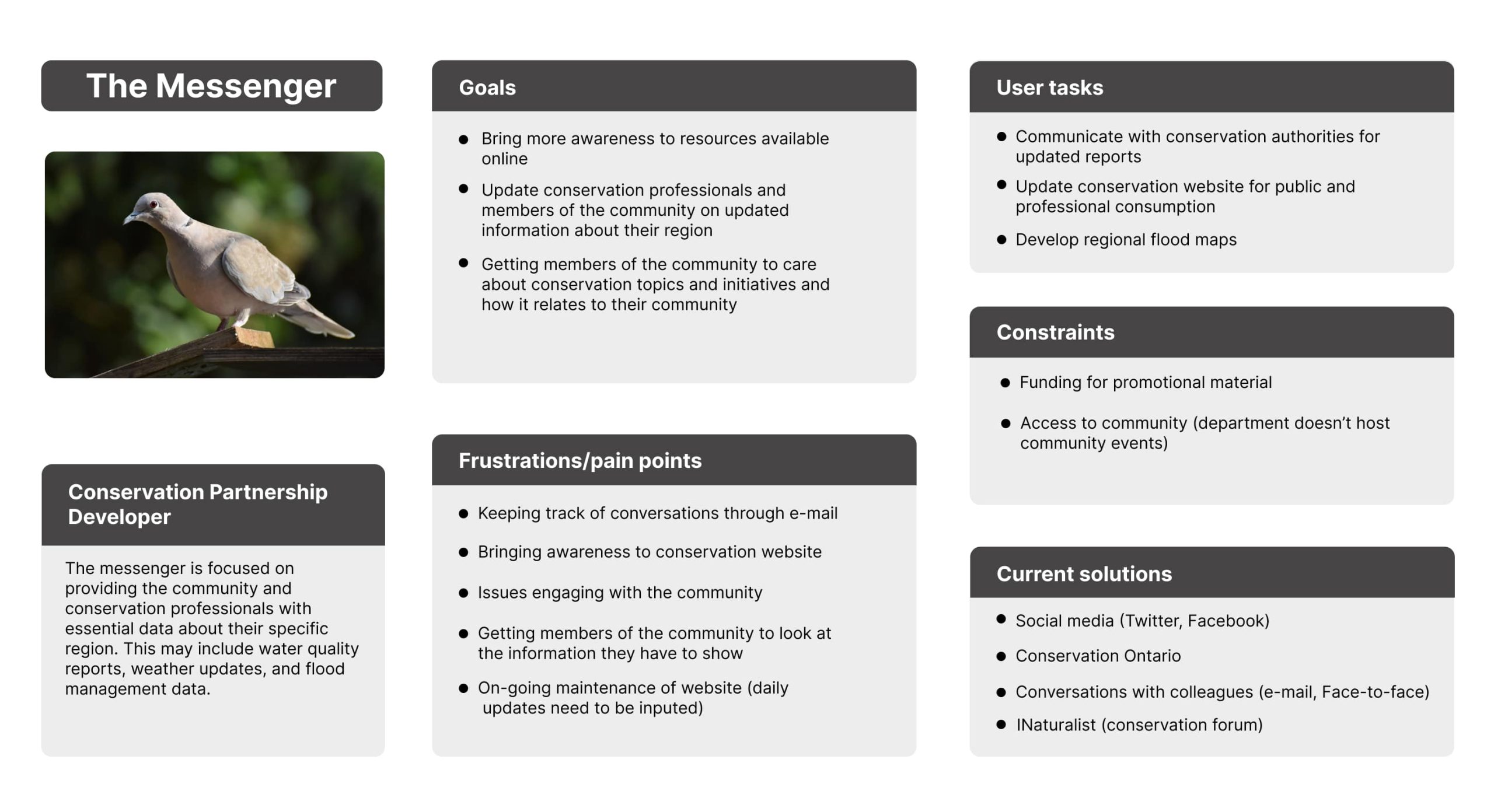
Messenger

“We’re working on the same projects and making the same mistakes because we aren’t sharing information”

Individuals from this category often find committing the same mistakes as other fellow members of the conservation community. This becomes one of the major reasons why updating information takes longer than it ideally should.

The Bridge

“They don’t really know that our organization exists or the kind of work we’re doing”

This role is crucial for raising societal awareness and ensuring conservationists can access relevant resources by building relationships within and outside the community.

Pivot

After conducting our initial usability testing with the low fidelity prototype, we found a major flaw in the information architecture of the research platform.

PROBLEM: Confusing, Siloed Content

Users had to guess where to find information, leading to frustration. One user stated, “I think you need to have an easier way to find case studies…it’s going to be hard for them.”

SOLUTION: Unified & Filterable Library

Based on direct feedback, we unified all content and added a robust filtering system, matching the user’s mental model for finding information efficiently.

Our Solution

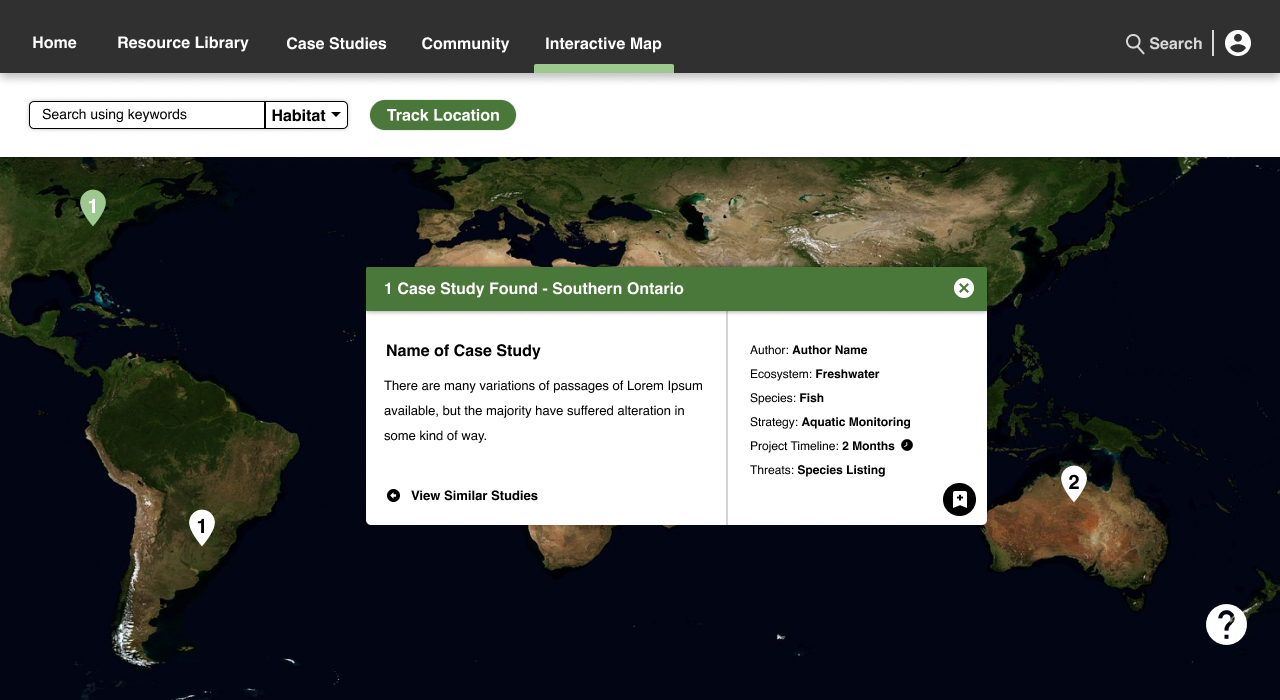
To enable efficient research practices, our solution employs filters on the search results as well as a dedicated search functional called interactive map which is an easy to use location based search

Saving links, files and documents can be cumbersome especially when frequenting between multiple websites. Therefore, our solution gives visitors option to bookmark relevant resources and save them in folders on the portal itself.

The design features information snippets on search results and landing pages, including author name, timeline, cost, and ecosystem type, to help readers quickly assess relevance.

To promote collaborative research and fostering a sense of community, the design includes a discussion forum for advice and connections. Users can share bookmarked folders with others to view or add/edit resources, based on configured permissions.

To tackle one of the most common challenges, outdated information, our design includes a ‘Request an Update’ feature which lets users notify the authorities of incorrect or outdated information.

Based on the filters used to acquire an article/case study from search result, the related articles are also optimized

Problems Solved

Taking into account the technical constraints at William & Mary paired with the behavioural patterns of the target audience, our team was able to tackle the primary challenges being faced at the moment by conservationists around the globe.

User Feedback

It’s about safeguarding our environment, enhancing research efficiency, fostering community engagement, and ensuring the well-being of our planet. By addressing this problem, we’re on a mission to make conservation more effective, efficient, and exciting.

Conservation professionals face the challenge of accessing verified information relevant to their research

Usability Testing

Key Tasks

Navigate the interactive map to discover and gather insights on diverse conservation initiatives in Southern Ontario, understanding strategies and techniques for sustainability and environmental protection.

Craft a well-researched discussion post on project challenges, connecting with fellow conservationists online to explore potential solutions, gain meaningful insights, and identify innovative approaches for informed decision-making.
Save a case study for future retrieval using the platform’s bookmarking functionality and folders. Streamlining access ensures quick retrieval without time-consuming searches.

Research and locate specific tool information within a report, gaining a comprehensive understanding of its application. This task informs decision-making, project planning, and ensures the selection of appropriate tools for the project.

Submit a formal update request for an outdated case study, addressing the author or publisher. The goal is to bring awareness to newer, relevant information, ensuring the case study reflects the most accurate and up-to-date insights for informed decision-making.